Olivia’s Neurodiverse Heart & Peace Blog
He’ll Hang with His Buddy—But Not Plan a Date with Me?
When you buy through our links, we may earn a commission and as an Amazon Associate, I earn from qualifying purchases.
😤Date with Me vs. Buddies
You’ve asked him—nicely.
You’ve hinted. You’ve reminded.
You’ve even sent him the OpenTable link yourself.
But somehow, your autistic husband just… doesn’t plan date nights.
Yet, without hesitation, he’ll text his one favorite buddy and head out for drinks, a hobby meet-up, or hours of conversation around their shared interest.
And you’re left thinking:
“He has energy for that—but not for me?”
“I feel invisible, rejected, and like I’m the ‘hard’ one in his life.”
“Why does everyone else get the fun, relaxed version of him—and I get silence and stress?”
Let’s break this down, not to excuse it—but to help you understand the real reasons, and what you can do about it without self-blame or endless resentment.
🧠 The Hidden Reasons He’s More Relaxed with His Buddy Than with You
This dynamic is extremely common in neurodiverse relationships—especially when the wife is neurotypical and the husband is autistic.
Here’s what may really be happening:
1️⃣ Low-Pressure vs. High-Stakes
With his buddy, there’s no emotional performance required.
With you, there’s pressure to do it “right,” be romantic, read cues, and meet your unspoken needs.
What feels like an effortless dinner to you may feel like a minefield to him:
“What if I say the wrong thing?”
“What if I forget the right emotional response?”
“What if she gets hurt and I don’t understand why?”
It’s not that he doesn’t care. It’s that he’s anxious—and the stakes feel sky-high.
2️⃣ Shared Interests = Less Translation
When he’s with his friend, they likely bond over logic, facts, a shared hobby, or routine topics.
There’s no need to decode facial expressions, manage feelings, or jump between emotional layers.
With you, even though your love is safe, he may feel like he’s constantly failing some invisible emotional test.
3️⃣ Familiar Scripts vs. Open-Ended Emotional Work
Many autistic men thrive in situations with clear expectations and predictable outcomes. Friend hangouts often follow that rhythm.
Date night, on the other hand?
What will we talk about?
What emotional connection is expected?
Will there be “deep” conversation I’m not ready for?
Even if unspoken, that pressure can lead to avoidance—not out of malice, but overwhelm.
💔 Why This Hurts So Much (And You’re Not Crazy for Feeling That Way)
Let’s validate you here:
You want to feel wanted, not just tolerated
You want to be the person he chooses, not the person he avoids
You want romance, effort, and shared joy, not just logistics and problem-solving
This isn’t about being needy.
It’s about being a partner in a marriage—not just the scheduler, emotional interpreter, or quiet roommate.
🧡 Discover the step-by-step playbooks that help both of you.
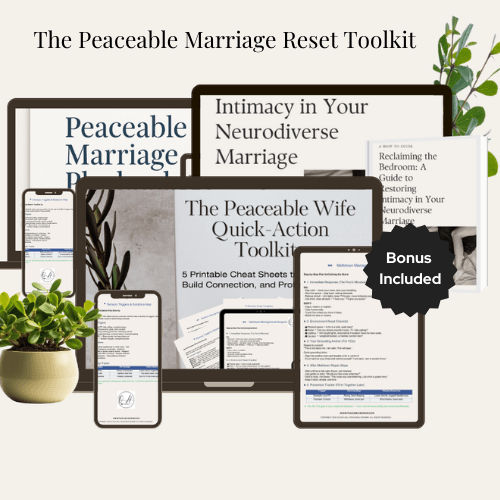
The Peaceable Marriage Reset Toolkit. Finally Understand Each Other, Build Emotional Safety, and Reclaim Peace in Your Neurodiverse Marriage — Without Exhaustion, Guilt, or Endless Explaining.💖
💡 What You Can Do to Shift This Pattern (Without More Resentment)
✅ 1. Reframe, Then Request with Structure
Instead of asking for a “date night,” try:
“I’d love for us to go to dinner Friday. I’ll make the reservation. Can you choose what time we leave and which place feels most comfortable?”
This gives him:
A clear task
Predictable boundaries
Shared responsibility without emotional vagueness
✅ 2. Name the Real Need Behind the Ask
“When you plan things with your friend but not with me, I start to feel unimportant—even though I know that’s not your intent. I need to feel like I’m fun to be with too.”
Most autistic partners don’t realize their behavior is sending a message of rejection. Naming your feelings helps bridge the gap—without guilt-tripping.
✅ 3. Introduce “Low-Stress Together Time”
Not every connection has to be a grand gesture.
Try:
Weekly coffee dates in the living room
Going to the grocery store together and grabbing a snack
Watching a show while holding hands
Create routine ways to feel close that don’t rely on his executive function to plan everything.
✅ 4. Celebrate When He Does Try
Even if it’s awkward or late or not your ideal version—praise the effort.
“Thanks for taking the lead on this, even if it’s small. I feel seen when you try.”
Positive reinforcement helps create new habits without shame.
🧡 Final Thought: You’re Not Asking Too Much—You’re Asking Differently
It’s okay to want connection.
It’s okay to feel frustrated when you’re constantly managing both the emotional needs and the logistics.
But when you understand how your partner’s brain works—and begin to ask for connection in ways that he can process—it can shift your marriage from constant disappointment to steady connection.
You might not get spontaneous flowers and surprise dinners.
But you can get consistency, shared experiences, and emotional safety—built on purpose, not pressure.
📘 Want a Practical, Hopeful Guide for Navigating Neurodiverse Marriage?
Grab my book:
You’re Not Crazy! He’s Autistic: (2 Books in1) Guide & Journal for Women
Inside:
Scripts for asking what you really need
Prompts for expressing emotions clearly
Real examples of what works—and what doesn’t—for women just like you

Need More Support? Get Help with Your Marriage Today!
LET'S STAY CONNECTED!
JOIN OUR VIP NEWSLETTER TODAY!

You're Not Alone!
xX Olivia Hall