Olivia’s Neurodiverse Heart & Peace Blog
I Love Him—But I Still Need Me
When you buy through our links, we may earn a commission and as an Amazon Associate, I earn from qualifying purchases.
🌸More Self-Care, Less Guilt
You’re married. You’re committed. You love your husband deeply.
But if you’re honest, you're also feeling emotionally depleted.
Why?
Because when you're married to a high-functioning autistic partner, the relationship often requires more emotional labor, communication translation, and flexibility—from you.
It can feel like:
You’re always planning, adapting, soothing, or explaining.
You miss connection, conversation, and companionship.
You’ve started to lose touch with the you that existed before the relationship.
And yet… you feel guilty.
Guilty for needing something more. Guilty for going places without him. Guilty for laughing freely with friends when he’s not there.
But here’s the truth:
You’re not selfish. You’re not abandoning your marriage. You’re practicing healthy, necessary self-care.
💛 Why Self-Care Is Non-Negotiable in Neurodiverse Marriage
In neurodiverse marriages, emotional reciprocity is often uneven. That doesn’t mean your partner doesn’t love you—it just means you may not get your emotional, social, or sensory needs met in the traditional ways.
That’s why external support and outlets are critical.
Without them, you risk:
Emotional burnout
Resentment buildup
Loss of identity
Increased isolation
Self-care isn’t selfish.
It’s what allows you to show up whole in your marriage.
🌿 5 Key Ways to Care for Yourself (Without Resentment or Guilt)
✅ 1. Normalize Doing Things Alone (Even Married)
Your partner may struggle with crowds, noise, or spontaneous events. That doesn’t mean you have to stay home too.
You’re allowed to go to girls' night.
You’re allowed to attend weddings, concerts, or church events by yourself.
You’re allowed to say, “I’d love for you to come, but I’m going even if you don’t.”
This isn’t rejection. It’s reality with grace.
🎯 Pro Tip:
Have a shared calendar or gentle routine where each of you lists solo and joint plans for the week. This keeps your life balanced without blame.
✅ 2. Build a Support Network That “Gets It”
You may feel like your friends and family don’t understand what it’s really like being in a neurodiverse marriage. And they might not.
But the answer isn’t isolation. The answer is intentional connection.
Try this:
Join a private support group for neurotypical wives
Keep one or two close friends who don’t judge or try to "fix" your marriage
See a therapist who understands autism spectrum relationships
You need a place to vent, process, and laugh—without needing to explain everything.
✅ 3. Practice Joy Without Apology
It’s okay to enjoy things that don’t include him.
You’re allowed to feel:
Alive at your favorite yoga class
Connected during a brunch with friends
Fulfilled at a retreat or women’s event
And you don’t need to feel guilty if he stayed home.
This is part of building a sustainable, realistic, and joy-filled life.
💬 Affirmation:
“I can love my husband and pursue my joy. My happiness doesn’t depend on his participation.”
✅ 4. Create “Recharge Time” That Belongs to You
Set aside regular, non-negotiable time for yourself—even if it’s just 30 minutes a day.
Ideas:
Walks alone with music or prayer
Reading at a local coffee shop
Watching a show he doesn’t enjoy
Journaling about your emotions without editing yourself
This is not “extra.” This is maintenance for your mental health.
✅ 5. Let Go of the Resentment Loop
The truth? You may still wish he were more socially engaged, emotionally attuned, or willing to do more with you.
But chronic resentment will steal your joy and sabotage connection.
Try shifting from:
“He never wants to do this with me.”
To:
“This fills me up, so I’m going to enjoy it—and love him without needing him to join every part of it.”
You don’t need a partner who mirrors your every move.
You need a partner who respects your freedom—and a YOU who honors your own needs.
🧡 Discover the step-by-step playbooks that help both of you.
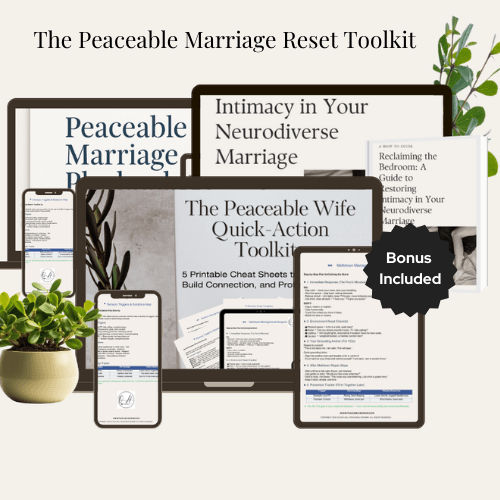
The Peaceable Marriage Reset Toolkit. Finally Understand Each Other, Build Emotional Safety, and Reclaim Peace in Your Neurodiverse Marriage — Without Exhaustion, Guilt, or Endless Explaining.💖
💡 Final Thought: Healthy Autonomy Makes You a Better Partner
Married doesn’t mean merged.
And love doesn’t mean sacrifice to the point of invisibility.
When you practice self-care, maintain a life outside your marriage, and tend to your individual joy, you actually become:
More present
More grounded
Less resentful
More you
And that version of you?
She’s the one who can love deeply, set boundaries gently, and build a life that’s both shared and self-honoring.
📘 Want to Reconnect with You (and Your Marriage)?
Explore my book:
You’re Not Crazy! He’s Autistic: A 2-in-1 Guide & Journal for Women
Inside:
Emotional validation and practical tools
Self-care prompts and personal boundaries
Gentle guidance for building a life you love—with or without full emotional reciprocity
LET'S STAY CONNECTED!

You're Not Alone!
xX Olivia Hall