Olivia’s Neurodiverse Heart & Peace Blog
Married and Misunderstood?
When you buy through our links, we may earn a commission and as an Amazon Associate, I earn from qualifying purchases.
💍Did I Marry the Wrong Man?
You said yes. You walked down the aisle.
And now… you’re wondering if you married the wrong person.
Not because you don’t love him. You do.
But this first year of marriage feels harder, lonelier, and more confusing than you ever imagined.
You're not crazy. You're not failing.
You may just be in a neurodiverse marriage—where one partner (likely your husband) is on the autism spectrum, and the other (you) is neurotypical.
Newlywed life is hard enough.
But when you add communication differences, emotional mismatches, and sensory needs, it's not just hard—it can feel impossible.
But it’s not.
With the right tools and expectations, you can build a strong, connected, joy-filled life together.
Here’s what you need to know if you’re newly married in a neurodiverse relationship. 👇
🧠 1. Love May Not Look the Way You Expect It To
Your husband might not express love through long talks or deep emotional check-ins.
He might show it through fixing your car, doing the same sweet routine every day, or staying loyal without needing constant validation.
That doesn’t mean he doesn’t love you.
It means he loves differently.
💬 Try This:
Start learning each other’s “love languages”—not just the classic five, but neurodiverse versions like consistency, problem-solving, or personal space.
🧩 2. Emotional Mismatches Are Real (and Common)
You might crave emotional connection, shared feelings, or cozy heart-to-hearts.
He might freeze, shut down, or respond with logic instead of empathy.
It’s not rejection. It’s not coldness.
It’s often a neurological difference in emotional processing.
💬 Try This:
Use structured conversation tools (like written prompts or the “5-Minute Check-In” method) to build emotional connection without overwhelming him.
🧡 Discover the step-by-step playbooks that help both of you.
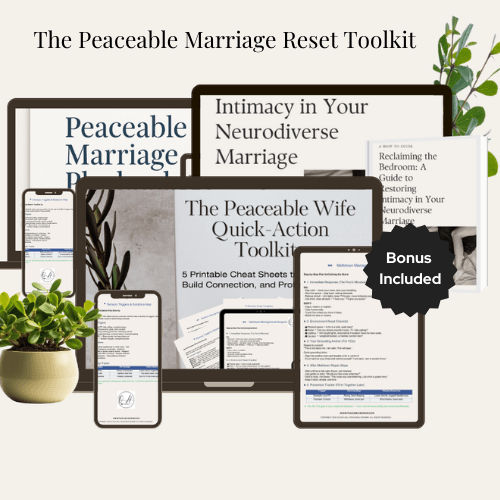
The Peaceable Marriage Reset Toolkit. Finally Understand Each Other, Build Emotional Safety, and Reclaim Peace in Your Neurodiverse Marriage — Without Exhaustion, Guilt, or Endless Explaining.💖
🔁 3. Routines Are His Safety Net
Many autistic husbands thrive on predictability. Changes—even small ones—can cause stress or confusion.
You might want spontaneous date nights.
He may want the same Friday pizza and familiar movie.
💬 Try This:
Create “safe structure” with room for flexibility. For example:
🗓️ Fridays = date night, but you get to rotate the activity with 24 hours’ notice.
🛠️ 4. You're Not the Therapist (or the Mother)
It’s tempting to guide him through social rules, regulate his emotions, and plan everything.
But that creates resentment—for both of you.
💬 Try This:
Start using adult-to-adult language like:
“What do you think we could do differently next time?”
“I need help with __. How can we divide that?”
Set boundaries and offer structure. That’s partnership, not parenting.
💛 5. You BOTH Need Support
Most newlywed advice assumes you're on the same neurological page. You're not—and that's okay. But you’ll need guidance that reflects your reality.
You may feel:
Lonely (even though you're married)
Emotionally exhausted
Confused why love doesn’t feel the way it "should"
You’re not alone. You just need the right map.
💬 Try This:
Find resources made for neurodiverse couples—books, coaches, or groups that understand the difference between malice and misunderstanding.
💡 Final Thought: Marriage Isn’t a Fairytale. But It Can Be Beautiful.
Neurodiverse newlyweds don’t fail because they don’t love each other.
They fail because they’re using the wrong tools.
But when you:
Learn how he communicates
Advocate clearly for your needs
Celebrate what’s working (not just what’s missing)
You build a love story that’s deep, steady, and real.
Even if it looks different from anyone else’s.
📘 Want the Map?
Grab the book made just for you:
You’re Not Crazy! He’s Autistic: (2 Books in1) Guide & Journal for Women
Inside, you’ll find:
Relationship tools tailored for neurodiverse marriage
Emotional validation and practical scripts
Journaling space to reconnect with yourself again
LET'S STAY CONNECTED!

You're Not Alone!
xX Olivia Hall